
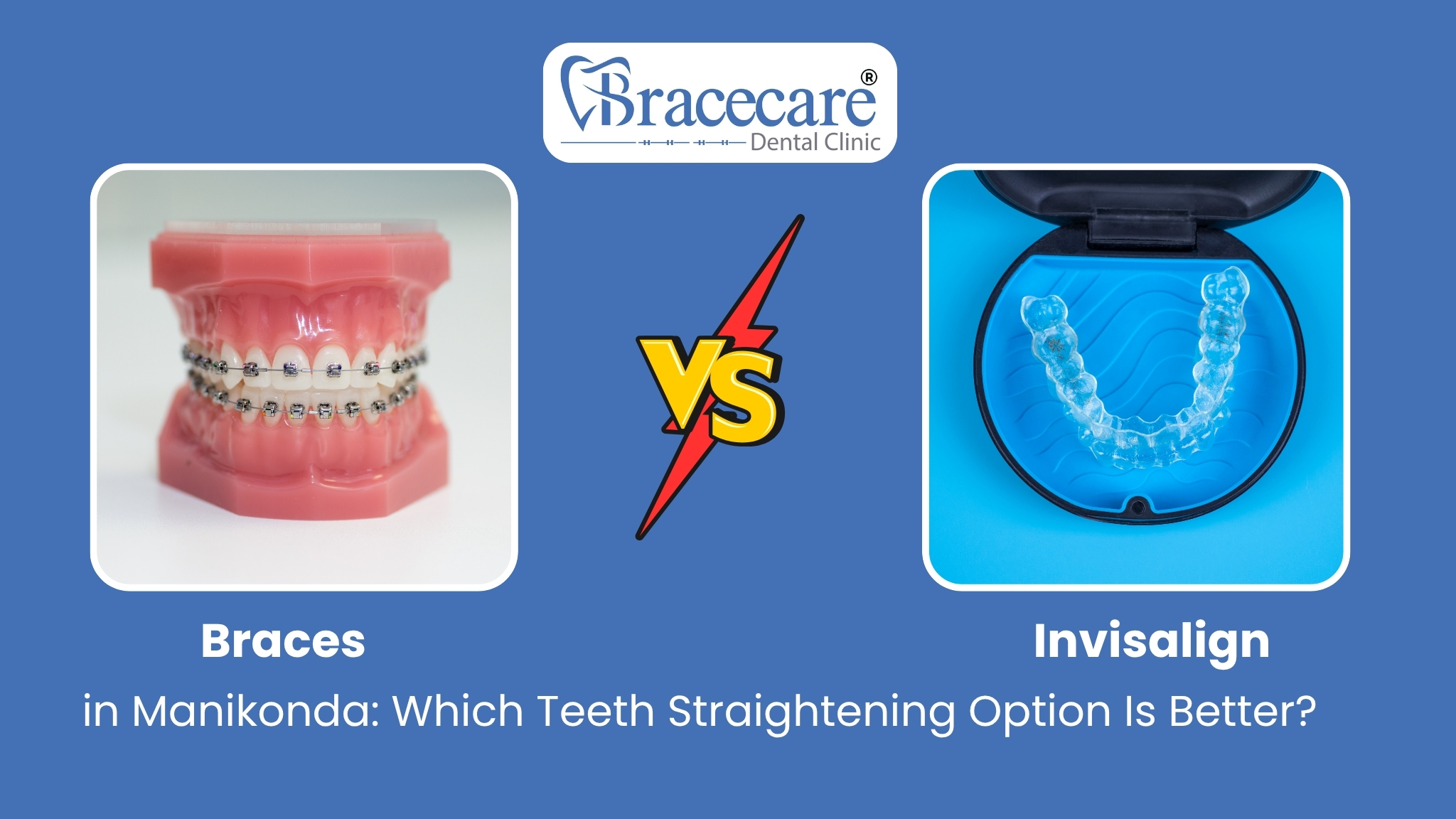
A straighter smile can improve both appearance and oral function, but choosing the right orthodontic treatment is an important decision. Today, patients looking for Teeth Straightening in Manikonda commonly compare traditional braces with Invisalign and other clear aligners.
Both options can correct tooth alignment problems, but they differ in appearance, comfort, maintenance, lifestyle requirements, treatment suitability, and cost.
If you are searching for Braces vs Invisalign in Manikonda, the most suitable choice depends on your orthodontic condition, treatment goals, lifestyle, and your orthodontist’s recommendation. Bracecare Dental Clinic in Manikonda provides both conventional orthodontic treatment and clear-aligner options.
What Is the Difference Between Braces and Invisalign?
Traditional braces use brackets and wires attached to the teeth to apply controlled forces and gradually improve tooth alignment.
Invisalign uses a series of customized, transparent aligners that gradually move the teeth toward their planned positions. The aligners are removable and are designed to be much less noticeable than conventional braces.
The choice is therefore not simply about which treatment looks better. Your orthodontist needs to determine which system is appropriate for your particular alignment and bite concerns.
Braces vs Invisalign: Quick Comparison
| Feature | Invisalign / Clear Aligners | Traditional Braces |
|---|---|---|
| Appearance | Nearly invisible | More noticeable |
| Design | Clear removable trays | Brackets and wires |
| Removable | Yes | No |
| Eating | Aligners removed during meals | Some food restrictions |
| Oral hygiene | Easier to brush and floss | Requires additional cleaning around brackets |
| Compliance | Requires consistent wear | Fixed to teeth |
| Comfort | Smooth plastic aligners | Brackets/wires may cause irritation |
| Suitability | Many mild-to-moderate cases | Broad range, including complex cases |
| Follow-up | Periodic monitoring | Regular adjustments |
| Cost | Generally higher | Depends on brace type |
Bracecare Dental’s comparison information highlights the discreet appearance, removability, oral-hygiene convenience, and fewer adjustment requirements associated with clear aligners, while traditional braces remain an effective option for more complex orthodontic problems.
How Do Traditional Braces Work?
Traditional braces use brackets attached to the teeth and an archwire that applies controlled forces.
During treatment, the orthodontist periodically evaluates tooth movement and makes necessary adjustments.
Because braces remain fixed to the teeth, patients do not have to remember to wear them. This can be an advantage for children, teenagers, or anyone who may find it difficult to consistently wear removable aligners.
Traditional braces can also be useful for complex alignment and bite problems where a fixed orthodontic appliance may be recommended.
How Does Invisalign Work?
Invisalign Treatment in Manikonda involves a series of customized clear aligners.
Each aligner is designed to guide specific tooth movements. Patients progress through the aligners according to their orthodontist’s instructions.
Bracecare Dental recommends wearing clear aligners for approximately 20–22 hours per day and following the prescribed treatment schedule.
Because Invisalign is removable, patients can take the aligners out for meals and oral hygiene.
Which Looks Better: Braces or Invisalign?
If appearance is a major consideration, Invisalign generally has an advantage.
The transparent aligners are designed to be discreet, making them attractive to adults, professionals, students, and anyone who does not want visible brackets and wires.
Traditional braces are more noticeable, although ceramic braces can provide a less visible alternative to conventional metal braces.
If your priority is discreet orthodontic treatment, Invisible Braces in Manikonda may be worth discussing with an orthodontist.
Which Is More Comfortable?
Comfort varies from person to person.
Invisalign aligners are made from smooth plastic and do not have metal brackets or wires. You may experience pressure or mild discomfort when changing to a new aligner as the teeth begin moving.
Traditional braces can sometimes cause irritation from brackets and wires, particularly after placement or adjustments.
Bracecare Dental describes clear aligners as a comfortable option because they do not contain the brackets and wires associated with traditional braces.
However, neither treatment should be expected to be completely sensation-free throughout the entire orthodontic process.
Which Is Easier to Maintain?
Invisalign
With Invisalign, you can remove the aligners for brushing and flossing. This allows you to maintain your usual oral-hygiene routine more easily.
The aligners themselves also need to be cleaned regularly.
Traditional Braces
Braces remain attached to your teeth, so brushing and flossing around brackets and wires requires additional care.
Food can become trapped around orthodontic components, making thorough cleaning particularly important.
For patients who prioritize convenient oral hygiene, Clear Aligners in Manikonda may be an appealing option.
Can You Eat Normally With Invisalign?
One of the major lifestyle advantages of Invisalign is that the aligners are removable.
You can remove them before eating, allowing you to continue enjoying a wide range of foods.
With traditional braces, certain hard, sticky, or chewy foods may need to be avoided because they can damage brackets or wires.
After eating, patients should clean their teeth appropriately before putting their aligners back in.
Which Is Better for Crowded Teeth?
Both braces and clear aligners can be used to treat crowded teeth, but suitability depends on the severity and characteristics of the crowding.
Bracecare Dental states that invisible braces can be used for overcrowded teeth, crooked teeth, gaps, overbite, and underbite. It also notes that complex cases may require traditional braces.
For Crowded Teeth Treatment in Manikonda, an orthodontic assessment is therefore important before deciding between Invisalign and braces.
Which Is Better for Complex Orthodontic Problems?
Traditional braces may be recommended when more complex tooth movements or significant bite corrections are required.
Clear aligners have expanded significantly in their capabilities, but not every orthodontic problem is suitable for aligner treatment.
Bracecare Dental’s published comparison specifically identifies traditional braces as an option for severe orthodontic problems and complex bite corrections.
This is why choosing treatment based only on appearance can be misleading. The priority should be selecting an approach that can appropriately address your orthodontic condition.
Which Treatment Is Better for Adults?
For many adults, Invisalign is attractive because it is discreet and removable.
Working professionals may prefer clear aligners because they are less noticeable during meetings, presentations, photographs, and social situations.
However, adults can also successfully undergo traditional braces. Ceramic braces may be another option for patients who want a less noticeable fixed appliance.
The best choice depends on your orthodontic requirements and personal preferences.
Which Is Better for Teenagers?
Both options can be suitable for teenagers.
Invisalign requires consistent compliance because the aligners need to be worn for the recommended number of hours each day.
Traditional braces are fixed, so there is no need to remember to put them back in after meals.
Bracecare Dental notes that traditional braces can be particularly appropriate for patients who may have difficulty consistently wearing removable aligners.
How Long Does Invisalign Take Compared With Braces?
Treatment duration varies significantly from one patient to another.
Bracecare Dental states that invisible-brace treatment typically takes approximately 6–18 months, depending on alignment severity and patient compliance.
Traditional braces can also require different treatment durations depending on the complexity of the case.
It is important not to choose a treatment simply because it appears faster. The orthodontist should determine an appropriate treatment timeline based on your specific condition.
Invisalign vs Braces: Which Requires More Discipline?
Invisalign requires active participation from the patient.
Because the aligners are removable, you need to wear them according to the prescribed schedule and remember to put them back after eating and cleaning your teeth.
Traditional braces are fixed, which reduces the possibility of accidentally under-wearing the appliance.
If you are highly consistent and comfortable following daily instructions, Invisalign can provide significant lifestyle flexibility.
Which Treatment Is More Expensive?
The cost depends on the type of braces, complexity of your orthodontic problem, treatment duration, technology used, and other components of your treatment plan.
Bracecare Dental’s published Hyderabad pricing guide lists approximate ranges of:
Metal braces: ₹20,000–₹80,000
Ceramic braces: ₹30,000–₹1,50,000
Clear aligners: ₹1,00,000–₹3,50,000
These are indicative ranges published by the clinic rather than guaranteed prices. Your individual Braces and Invisalign Cost in Manikonda depends on your diagnosis and treatment plan.
What Factors Affect the Cost?
Several factors can influence the overall price of orthodontic treatment:
- Complexity of the alignment problem
- Type of orthodontic appliance
- Treatment duration
- Number of aligners required
- Need for refinements
- Diagnostic procedures
- Follow-up appointments
- Retainers after active treatment
Therefore, comparing only the starting price of braces and Invisalign may not provide an accurate picture of the total treatment investment.
Which Treatment Has Fewer Food Restrictions?
Invisalign generally provides greater flexibility.
Since aligners are removable, you can take them out while eating.
With fixed braces, certain hard, sticky, or chewy foods may need to be avoided to reduce the risk of damaging orthodontic components.
For patients who place a high value on maintaining their usual diet, removable aligners may be more convenient.
Which Treatment Requires More Dental Visits?
The number and frequency of appointments depend on the individual treatment plan.
Bracecare Dental notes that clear aligners typically require fewer orthodontist visits than traditional braces because there are no routine wire-tightening appointments.
However, regular monitoring remains important with either treatment.
Can Invisalign Treat Gaps and Bite Problems?
Invisalign can be used for various alignment concerns, including certain cases involving gaps, crowding, overbite, underbite, and other orthodontic issues.
Bracecare Dental lists several of these conditions among the problems that can be addressed using invisible braces.
The complexity of the bite problem determines whether Invisalign or traditional braces are more appropriate.
Braces vs Invisalign: Which Is Better for You?
There is no single treatment that is universally better.
Invisalign may be a good option if you:
- Want a discreet treatment
- Prefer removable aligners
- Want easier brushing and flossing
- Prefer fewer food restrictions
- Can consistently wear your aligners
- Have an orthodontic condition suitable for clear aligners
Traditional braces may be preferable if you:
- Have a complex orthodontic problem
- Need significant bite correction
- Prefer a fixed appliance
- May struggle to consistently wear removable aligners
- Want an established treatment option for a broad range of orthodontic problems
The final decision should be made after an orthodontic evaluation.
Why Choose Bracecare Dental Clinic in Manikonda?
If you are looking for Braces Treatment in Manikonda or Invisalign Treatment in Manikonda, Bracecare Dental Clinic offers both traditional orthodontic treatments and clear-aligner solutions.
The clinic highlights personalized treatment planning, digital technology, and orthodontic expertise. Its published Invisalign information identifies Dr. Madhukar Reddy as an experienced orthodontist with more than 15 years of experience.
Bracecare Dental Clinic – Manikonda | Invisalign Hyderabad is located at Rachala Enclave near Lanco Hills Road, Manikonda, Hyderabad.
Questions to Ask Your Orthodontist
Before choosing between Braces and Invisalign in Manikonda, ask:
Is Invisalign suitable for my specific orthodontic problem?
Would traditional braces provide a more predictable result in my case?
How long is my expected treatment?
What will the total treatment cost include?
Will I need refinements or additional aligners?
What type of retainer will I need after treatment?
How frequently will I need follow-up appointments?
These questions can help you compare treatments based on your actual needs rather than marketing claims.
Frequently Asked Questions
Is Invisalign better than braces?
Neither option is universally better. Invisalign can offer advantages in appearance, removability, and convenience, while traditional braces may be more suitable for certain complex orthodontic problems.
Is Invisalign more expensive than braces?
In many cases, Invisalign or clear aligners have a higher initial cost than conventional metal braces. The actual price depends on case complexity and the treatment plan.
Can Invisalign fix crowded teeth?
Yes, Invisalign can treat many cases of mild to moderate crowding. More complex cases may require traditional braces or another orthodontic approach.
Are braces more painful than Invisalign?
Both treatments can cause temporary pressure or discomfort as teeth move. Invisalign does not have brackets and wires, which may reduce certain types of irritation, but individual experiences vary.
Can I eat normally with Invisalign?
You can remove Invisalign aligners while eating, allowing greater dietary flexibility. The aligners should be cleaned and replaced according to your orthodontist’s instructions.
How many hours a day should I wear Invisalign?
Bracecare Dental recommends approximately 20–22 hours of daily wear for Invisalign.
How long does Invisalign treatment take?
Treatment duration varies. Bracecare Dental states that invisible-brace treatment typically takes approximately 6–18 months, depending on the case and patient compliance.
Conclusion
When comparing Braces vs Invisalign in Manikonda, there is no universal winner.
Invisalign may be attractive if you prioritize a discreet appearance, removable treatment, easier oral hygiene, and lifestyle flexibility. Traditional braces may be a better choice when more complex tooth movements or bite corrections are required, or when consistent aligner wear may be difficult.
The most important step is an orthodontic consultation. An experienced orthodontist can evaluate your teeth and bite and explain whether Invisalign or Braces in Manikonda is more appropriate for your individual treatment goals.
Bracecare Dental Clinic offers both orthodontic options in Manikonda, allowing patients to discuss their choices and develop a treatment plan based on their dental condition, lifestyle, and expectations.

